
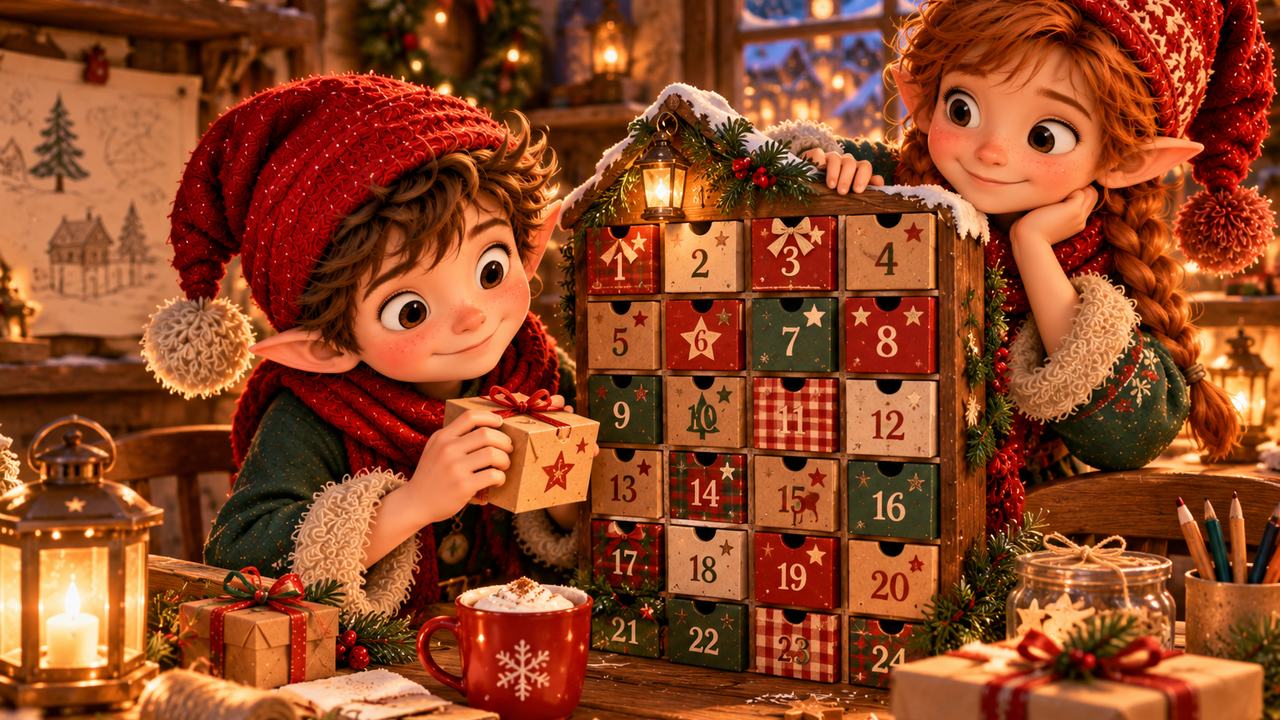
An Advent calendar is one of the easiest ways to make children feel that Christmas is really coming. One window a day organizes your time, teaches you patience and gives you a daily reason to be happy. But what should you put in it so that it doesn't get boring after a week and you don't run out of ideas after three weeks? Below you will find proven inspirations, divided by the type of calendar and the child's age.
Where did the Advent calendar come from?
The custom of counting down the days to Christmas originated in 19th-century Germany. Families drew 24 lines on the doors with chalk and erased one or lit another candle every day. The first printed calendars with windows appeared at the beginning of the 20th century, and chocolates appeared much later. The idea itself remains the same: each day brings us closer to Christmas Eve and each day brings a small surprise.
Today, the Advent calendar can take any form. What matters is the daily ritual, not the value of what is hidden in the window.
How to adjust the Advent calendar to the child's age?
The same calendar will please a three-year-old differently than a ten-year-old. Before you start collecting the contents, think about what your child likes and how much he or she can do on his own.
Toddlers (2–4 years)
The most important thing is simple, safe surprises and a familiar daily ritual. Stickers, stamps, crayons, small puppets or Christmas tree pendants will work well. Avoid small parts that a child could swallow. Little ones don't need a gift every day - just a picture to color or a card with a fun activity: "Today we're dancing to a Christmas song."
Preschoolers (4–6 years old)
This is the age when the magic of Christmas works the most. Children love stories, riddles and tasks "from elves". Mini-jigsaws, plasticine, glitter stickers, and cards with tasks to be completed together with the parent work well. At this age, a calendar with a story in which something new happens every day also works great.
Older children (7–12 years)
Older children will appreciate challenges, puzzles and little things related to their passion: trading cards, rubber bands for bracelets, mini science kits, bookmarks. You can also involve them in the preparations - let them come up with a few tasks for their younger siblings.
Advent calendar without sweets: 20 ideas for windows
Sweets in windows are a classic, but 24 chocolates is a lot of sugar. Here are the little things that will make you equally happy:
- thematic stickers (animals, vehicles, heroes of favorite fairy tales),
- stamps and a small ink pad,
- glitter crayons, markers or colored pens,
- mini-plasticine or salt dough in a jar,
- washable tattoos,
- Christmas tree pendant – new every year, with date,
- a key chain or a small figurine,
- socks with Christmas patterns,
- hairpins, hair bands, headband,
- puzzle in a bag (up to 50 pieces),
- mini-book or comic book,
- coloring book for one evening,
- origami making kit,
- seeds to plant in a pot,
- keychain flashlight for evening reading,
- a note with a coupon: "movie night", "breakfast in bed", "an extra hour before bed",
- a bag of artificial snow to play with,
- bookmark,
- a small lantern or LED Christmas tree light,
- a letter from the elf with a tip where to look for the next surprise.
Task calendar: 24 ideas for joint activities
The activity calendar consists of cards with tasks instead of gifts. Every day your child discovers what you will do together today. A few ideas to start:
- Bake and decorate gingerbread cookies.
- Write a letter to Santa Claus.
- Make a Christmas tree chain out of colored paper.
- Watch a Christmas movie under a blanket.
- Build a snowman or - if there is no snow - a cotton wool snowman.
- Choose a toy that your child will give to those in need.
- Make a bird feeder.
- Go for an evening walk and count the Christmas decorations on the balconies.
- Prepare Christmas cards for grandparents.
- Organize a home Christmas carol concert.
- Make hot chocolate with marshmallows.
- Put together a Christmas puzzle.
- Cut out paper snowflakes and glue them to the window.
- Read a Christmas story together.
- Dance to your favorite Christmas song.
- Decorate the Christmas tree.
- Take a family photo in Christmas sweaters.
- Draw a map of Santa's route from the Pole to your house.
- Prepare a small gift for your neighbor.
- Build a blanket fort and read in it with a flashlight.
- Make a decoration with pine cones and twigs.
- Record your wishes for the family together.
- Decorate the table for Christmas Eve.
- Christmas Eve: leave milk and cookies for Santa.
You don't have to follow this order. Schedule tasks that require more time, such as baking or decorating the Christmas tree, for weekends, and leave those that take fifteen minutes on weekdays. More ideas for quiet evening moments can be found in the article about Christmas fairy tales to read before bed.
DIY Advent calendar: what to make it from?
A self-made calendar can be the most beautiful decoration at home, and preparing it can be the first Christmas activity with your child. Some proven methods:
- Matchboxes - covered with colored paper and numbered, form a small chest of drawers. They can fit a sticker, a note or a candy.
- Toilet paper rolls - with bent ends create "candy" that can be hung on a branch or arranged in a honeycomb in a frame.
- Paper bags or envelopes – clipped to a string above the bed or on the wall. It's easy to replace their contents from year to year.
- Linen bags – reusable, hung on a branch or hanger. The calendar will last for several years.
- A jar with 24 pieces of paper – the simplest version of a task calendar. Each day, your child picks a slip at random or takes the next one in order.
If you're short on time, choose one reusable base - bags or boxes - and only change the contents every year.
Calendar of good deeds
Advent is a good time to show your child that Christmas is not only about receiving gifts. In the good deeds calendar, each box contains a small task for others:
- draw a card for their preschool teacher or the postman,
- help set the table without being reminded,
- call your grandma and tell her about your day,
- choose a book to donate to the library or community center,
- pour the grain into the bird feeder,
- say three nice things to someone.
Such a calendar goes great with small gifts: in the morning, the child discovers the task, and in the evening you talk about how it went. Children quickly notice that giving joy to others also brings joy.
Letters from an elf: a calendar full of secrets
For preschoolers and younger students, there's nothing more exciting than hearing from someone from the North Pole. Instead of a gift in the window, you can leave a short note from the elf every day - written in small handwriting, on decorative paper, sometimes with a bit of glitter.
The elf can tell you what's going on in Santa's workshop, ask for help with a task ("The reindeer lost the bell, will you look for it under the sofa?"), praise him for a good deed or leave a riddle leading to a hidden surprise. Such a calendar costs little and creates a festive atmosphere like nothing else.
If you lack inspiration for 24 letters, think about a ready-made story in which elves are the heroes and your child's name and dreams appear in their adventures.
Calendar with a story: a chapter for each day
More and more families choose a calendar in which a chapter of a story is a daily surprise. Instead of opening the window, the child learns the next chapter of the story, which develops throughout December and ends on Christmas Eve. Such a calendar:
- does not take up space and does not generate waste,
- builds an evening ritual of reading or listening together,
- develops imagination, vocabulary and ability to focus,
- gives an excuse to talk: "What do you think will happen tomorrow?"
You can prepare it yourself by reading one chapter of a longer Christmas book every day. You can also choose the personalized Elfindo Advent calendar - a Christmas story in 24 chapters, in which the child's name, interests and wishes from the letter to Santa Claus appear. Each chapter lasts approximately 8-12 minutes and is available as an audiobook and e-book, so you decide whether you read or listen today.
Practical tips so that your calendar doesn't become a chore
- Plan your content in advance. Write down 24 ideas in November. In December, when you're on the run, it's hard to be creative.
- Set a budget. A calendar doesn't have to cost more than one larger gift. The activities and story are free or cost little.
- Think about siblings. Two separate calendars mean double expense and the risk of comparisons. A shared calendar of activities or a story listened to together brings children together instead of dividing them.
- Choose a fixed time. In the morning with breakfast or in the evening before bed - the ritual works best when it is predictable.
- Leave room for flexibility. If you don't make it one day, nothing will happen. The calendar is meant to be enjoyable, not stressful.
- A unique finale. Let the window on December 24 be the most awaited: a letter from an elf, a shared task before Christmas Eve or the end of a story.
Frequently asked questions
When to start the Advent calendar?
Most often from December 1 to 24, regardless of when the first Sunday of Advent falls. Thanks to this, the calendar always has 24 windows, with the last one falling on Christmas Eve.
What to do if your child wants to open several windows at once?
Hang the calendar out of your child's reach or keep the surprises with you and put them in the window in the evening. When it comes to a calendar with a story, the rule “one chapter today, the next tomorrow” works well - curiosity about the next day is part of the fun.
How much does an Advent calendar for a child cost?
A task or DIY calendar can cost several zlotys, and ready-made calendars with toys can cost even several hundred. Set a starting amount and adjust the proportions of gifts and activities to it.
Does an Advent calendar have to include gifts?
No. For many children, the most valuable thing is time spent with their parents. A calendar with tasks or a story is remembered for years precisely because it is based on shared experience, not on things.