
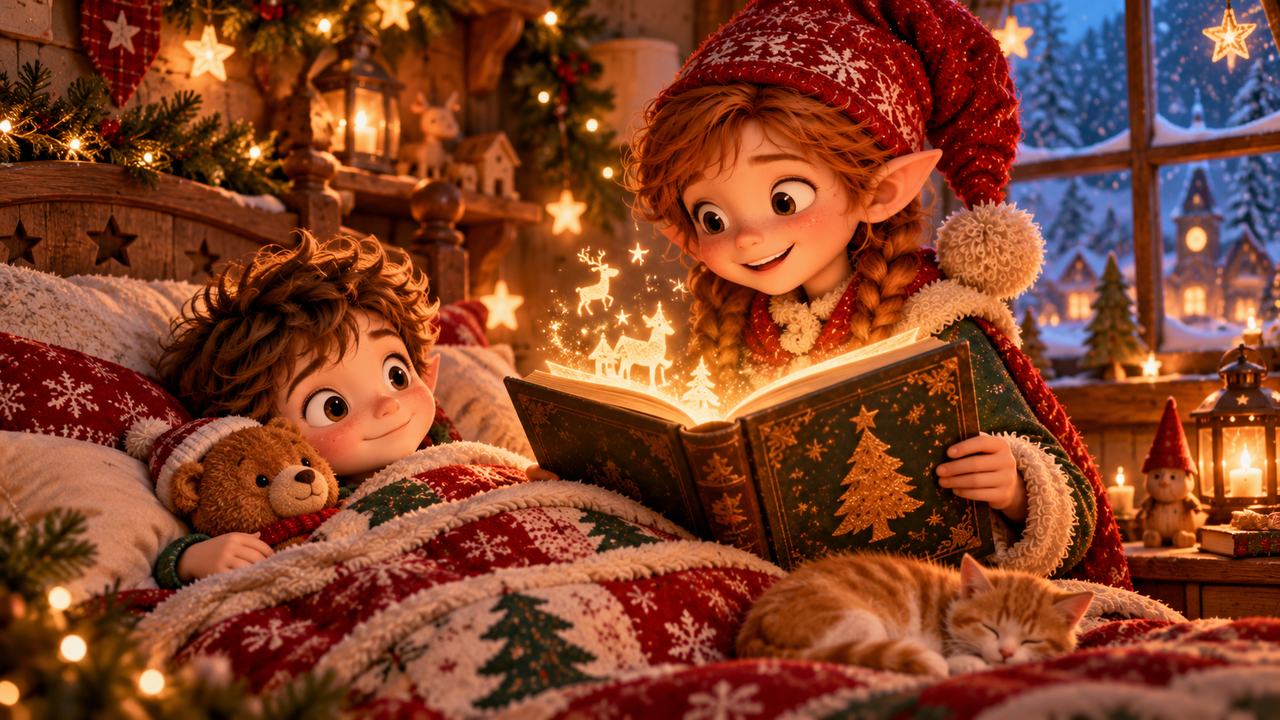
There is something about December evenings that encourages reading: it gets dark early, the lights twinkle in the windows, and children look forward to Christmas more and more every day. A Christmas fairy tale before bed allows you to tame this expectation and turn it into a calm, family ritual. Below you will find proven titles, ideas for reading in installments and some practical tips.
Why is it worth reading to children before bed?
Evening reading is much more than a way to fall asleep. A dozen or so minutes with a book:
- builds closeness - the child has a parent only for themselves, without a phone or rush,
- calms down - a predictable ritual signals that the day is ending,
- develops language - books contain words that we do not use every day,
- exercises imagination and attention - the child himself creates images in his head for the story he listens to,
- helps talk about emotions - it's easier to talk about fear, sadness or joy when the hero experiences them.
Christmas stories add something else to this: the feeling that something special is happening at home.
How to choose a Christmas fairy tale for a child's age?
2–4 years: short, rhythmic, pictorial
Children respond best to short, rhyming texts with large illustrations and repeated phrases. Just a few minutes of reading is enough. Board books about Santa Claus, reindeer and the Christmas tree, as well as picture books without words that can be "read" in your own words, work great.
4–7 years: fairy tales and short stories
Preschoolers and younger students enjoy listening to longer stories with vivid characters and a clear ending. This is a good time for the first fairy tales and short stories - one fragment every evening.
Ages 7-12: longer stories and classics
Older children will appreciate the extensive plot, humor and a bit of tension. They can now listen to the classics in the original or slightly shortened version, and read aloud to their younger siblings.
Classic Christmas stories worth knowing
These stories have accompanied children in December for generations. Many of them exist in several translations and adaptations - for younger children, choose the shortened and richly illustrated edition.
- "The Nutcracker and the Mouse King", ETA Hoffmann - Christmas Eve, toys coming to life and a battle with the mouse king. Choose an adaptation for younger children; older children may enjoy the full version read over several evenings.
- "The Snow Queen", Hans Christian Andersen - a fairy tale about the friendship of Gerda and Kay, divided into seven stories. Perfect for reading for a week, one part every evening.
- “The Fir Tree”, Hans Christian Andersen - the story of a small tree that dreams of becoming a Christmas tree. It encourages us to talk about enjoying the moment.
- “A Christmas Carol”, Charles Dickens – the transformation of the miserly Scrooge after visits from three ghosts. The full version suits children from around 9–10; choose an adaptation for younger listeners.
- “A Visit from St. Nicholas”, Clement C. Moore - also known as “The Night Before Christmas”: a rhythmic poem about the visit of Santa Claus, which largely shaped his modern image. Short, just right for little ones.
- Chapters about Christmas in “The Children of Noisy Village”, Astrid Lindgren - baking gingerbread, preparations and Christmas customs through the eyes of children. Warm and calm, perfect before bed.
- "The Snowman", Raymond Briggs - a wordless picture book about a boy and a snowman who comes to life at night. Parent and child tell it together.
- Polish Christmas Eve legends – animals speaking with human voices, an extra place at the table for an unexpected guest, or hay beneath the tablecloth. These short stories also help explain family traditions.
What fairy tale is good for bedtime?
Not every Christmas story is suitable for bedtime. Before going to bed, choose stories that:
- have a gentle pace and do not end at the most exciting moment,
- do not contain scenes that may be scary (dark forest, monsters, getting lost),
- end well or at least peacefully,
- last 5-15 minutes - as long as the child is able to listen attentively.
Save action-packed adventures for the afternoon. In the evening, stories about preparations for Christmas, friendship, helping others and waiting work better.
Advent reading in episodes
One of the most beautiful December rituals is reading one longer story throughout Advent: one chapter every evening, from December 1 to 24. This cycle works like an Advent calendar - only instead of chocolate, the daily surprise is a continuation of the story.
Children love this moment when they return to familiar characters and ask: "What happened yesterday?" It's a great memory exercise and a good excuse to talk about what might happen tomorrow.
If you are looking for a ready-made story for 24 evenings, check out the Elfindo Advent calendar. This is a Christmas story in 24 chapters about the adventures of Elfindo the elf and his friend Elfira, in which your child's name, interests and wishes from a letter to Santa Claus appear. Each chapter lasts about 8-12 minutes, and you can read the whole thing as an e-book or listen to it as an audiobook.
How to read so that your child calms down?
- Fixed time and place. First a bath and pajamas, then a book in bed. Repetition is a signal to the body that it's time to sleep.
- Dim light. Night lamp instead of overhead light. Put away your screens at least half an hour in advance.
- Calm voice. Read slower than usual and lower your voice towards the end. The various character voices are great, but no screaming.
- Let your child choose. Give two or three books to choose from. The feeling of influence reduces evening negotiations.
- Set a limit in advance. “We read one chapter” – and stick to this rule. Requests for “one more” show that your child enjoys the story, but the ritual is also important.
- A short conversation at the end. Asking “What did you like most today?” brings the evening to a close and helps the child sort out his or her emotions.
Make up your own Christmas fairy tale
Sometimes the best fairy tale is the one that is not in any book. An improvised story featuring your child, their favorite soft toy or the family dog can be more delightful than the most beautifully illustrated edition. If you don't know where to start, try this simple outline:
- Hero – your child, his favorite toy or a little elf.
- Problem - the star from the top of the Christmas tree was lost, the reindeer caught a cold, the letter to Santa flew away with the wind.
- Helper – sibling, grandma, pet, friendly snowman.
- Resolution – With courage, cleverness or kindness, everything ends well.
- A peaceful ending - the hero returns home to a warm bed and falls asleep.
Children love it when familiar places and names appear in stories. The same feeling of "this is about me" is created by a personalized story in which the child finds his or her own dreams and details of his or her world.
One fairy tale for siblings of different ages
Reading together to children of different ages can be a challenge: the older child may find the story “for babies”, while the younger ones get lost in the too-long plot. Some ways that help:
- Choose multi-layered stories. Good stories entertain younger children with adventure and older children with humor and detail.
- Give the older child a role. Let him read the dialogues of one of the characters, turn the pages or tell the younger one what happened yesterday.
- Ask questions on two levels. Ask the younger one what color the elf's hat was, the older one - why the hero made such a decision.
- Leave time for just one. If possible, once a week read to each child separately, something chosen especially for him.
Christmas library: books that come back every year
In many homes, Christmas books are hidden in a box with Christmas baubles after Christmas and only taken out in December. This is a simple way to make familiar titles feel special again. The children greet them as old friends, and looking through the box together is a separate, small ritual that begins Advent.
Every year you can add one new book to your collection - either chosen together or given by Santa Claus. Over time, a family library is created, and each book carries a memory of a specific Christmas. You can also write on the first page the year and name of the child to whom it was read for the first time.
When you don't have the strength to read: fairy tales to listen to
There are evenings when, after a long day, a parent lacks voice and energy. Then an audiobook or radio play is a good solution. Listening without a screen preserves what is most valuable in the evening ritual: imagination, peace and closeness, because you can listen together, cuddled under a blanket. You can read more about when to read a book and when to choose a recording in the article Audiobook or book – what to choose for children?.
Frequently asked questions
How long should you read before bed?
For toddlers, 5-10 minutes is enough, for older children, 15-20 minutes. Regularity is more important than length - a few minutes every day is more than an hour once a week.
When should you read Christmas fairy tales to your child?
From the first months of life. The baby will not understand the plot, but it listens to the melody of the voice and becomes familiar with the ritual. Short, rhyming texts are great for children who are just one year old.
What to do when your child wants the same fairy tale every night?
Read it. Repetition gives children a sense of security and helps them remember new words. You may want to suggest a new story from time to time as a second, shorter read.
Is it also worth reading aloud to older children?
Yes. Reading together with a ten-year-old is still a time of closeness, as well as an opportunity to reach for books that are a bit more difficult than those the child reads alone.